No snow in Sierra a bad sign for Valley

By Wayne Kirkbride
Modesto Bee
January 13, 2014

TWAIN HARTE – Here in the Sierra where I live, the snowfall we experienced in early December gave us hope that a normal snowpack would mean an end to the below-average precipitation of the prior year. As the snow melted with rising temperatures, it became evident we were in for another dry year. What worries me and the scientists who study climate is the history behind the West’s climate over the centuries.

In a recent report, a phenomenon called the Pacific Decadal Oscillation was suggested as a reason that a high pressure ridge has persisted over the state. Climatologist Bill Patzert, who works for NASA’s Jet Propulsion Laboratory, said droughts in California often are associated with a negative PDO, meaning a cooler northern Pacific Ocean. He says a negative PDO could signal that we are in the midst of a decades-long drought that began in 2000.

A doctoral candidate at Stanford, Daniel Swain, has studied relevant weather records dating to 1948; he believes such a persistent ridge has never been seen before.

Whether one accepts the planet is warming and changing weather patterns are due to man-made causes or believes natural forces are at work, or both, there are at least two more studies that should grab our attention as a wake-up call. One, done by the National Oceanic and Atmospheric Administration, studied tree-ring growth over the past 500 years.

“Longer records show strong evidence for a drought that appears to have been more severe in some of central North America than anything we have experienced in the 20th century, including the 1930s drought,” NOAA wrote.

A study of the bristlecone pine from the White Mountains of eastern California show multi- decadedroughts of the periods around A.D. 929 and 1299

Professor Scott Stine of California State University, East Bay, studied ancient tree stumps at Mono Lake and the Walker River in the Sierra. He found “evidence of medieval droughts of the Sierra that were the most severe of the past 4,000 to 7,000 years (from A.D. 900-1300). Conditions of the past 150 years drew down lakes and rivers well below their modern levels on numerous occasions during the late 18th and 19th centuries.”

Stine goes on: “Indeed, increasing evidence indicates that there is little that is climatically ‘normal’ about the past century and a half; it appears, in fact, to be California’s third or fourth wettest … period of the past four or more millennia. Since statehood, Californians have been living in the best of climatic times. Drier times undoubtedly lie ahead.”

The latest data confirming global warming caused by man do not negate studies that show that climate’s natural variability might be greater than previously known. Science must look back over centuries and even millennia to understand the weather cycle that might be swinging back around in our lifetime and certainly for the future population of the earth.

Maury Roos, of the California Department of Water Resources, said that about 35 percent of the state’s usable water comes from our Sierra snowpack.

That December storm is now just a memory. By Christmas, the weather was clear and 80 degrees in Southern California and low 70s in the north of the state.

The entire state needs to take steps immediately to conserve water. There might be a lot of economic and lifestyle changes ahead for all of us.

Kirkbride lives in Twain Harte and writes about Mother Lode and Sierra matters. Send questions or comments to columns@modbee.com.

Read article at ModBee.com.

Vernal Pools Conference 2014

AquAlliance proudly presents a 2014 conference:
  
Vernal Pools in Changing Landscapes: From Shasta to Baja
  
Conference: Thursday, April 10, 2014 from 9 a.m.to 5:30 p.m. at Sierra Nevada Brewing Company, Chico
  
Field trips: Friday, April 11, 2014 from 9 a.m. to 3 p.m. – various North State locations to be announced
  
Eminent scholars, agency representatives, and other professionals will present research and case studies regarding plant and animal species dependent on vernal pool landscapes, conservation efforts, legal cases, and management techniques that have been used to enhance the economic and biological viability of certain lands. Robert Holland, PhD will present the keynote address.
 
Click links to view:

Locals react to Bay Delta Conservation Plan

Barbara Vlamis E-R12.9.13 – By Heather Hacking, Chico Enterprise-Record — The environmental reports for plans for the Bay Delta Conservation Plan were released Monday, beginning a new flurry of debate.The $24.7 billion plan, seven years in the making, includes Gov. Jerry Brown’s proposal for 35 miles of tunnels that would move water under the Sacramento-San Joaquin Delta, rather than through a system of pumps in the south Delta that are known to harm fish.Opinions about the plan began flooding email boxes Monday morning, followed by notes from coalitions and a proposal for an alternative bond measure (see sidebar on Dan Logue).(For a compilation of press releases by Maven’s Notebook, see: http://goo.gl/ux9kN4).

Locally, Barbara Vlamis of AquAlliance said her group and a coalition of environmental organizations have been watching the BDCP process closely.

“One of the biggest things I have been hearing over and over again is that this thing doesn’t look like it can fly,” Vlamis said. She said it won’t protect the species as indicated, the funding is uncertain and the source for the water is unknown.

In the end, the best choice is less water export, she said.

That’s a hard sell to those in parts of the state that rely on Northern California water, she said. “It’s hard to crush somebody’s monetary dream.”

The Butte County Department of Water and Resource Conservation is just beginning to wade through the document to make comments, which can be submitted through April 14.

Public meetings (see list at: http://goo.gl/07ovKZ) will include 3-7 p.m. Jan. 23 at the Red Lion Hotel in Redding, 1830 Hilltop Drive.

Paul Gosselin, executive director of the county Department of Water, said the county will push to ensure regional water rights are protected, and to avoid “dead pool” conditions in Lake Oroville. Economic impacts to this area are another strong concern, he said.

“We are also concerned that in previous documents, an assessment of potential impacts to Butte County and the northern Sacramento Valley region were largely ignored,” Gosselin said.

Thad Bettner, manager of Glenn-Colusa Irrigation District, explained the BDCP is just one of many related water plans for the state.

Of primary concern is how the BDCP “may affect upstream operations, water rights and the environment,” Bettner said.

The document itself is tens of thousands of pages long, and water groups have “split up the workload” to study it, including consultants and groups Northern California Water Association, North State Water Alliance and water users along the American River system.

“We have a fairly large coalition, and a lot of common issues and concerns,” Bettner said.

Congressman John Garamendi was fairly direct in his press release, calling the plan a “boondoggle.”

In contrast, State Water Contractors have said the plan is the best chance to improve the environment in the delta, and provide water supply reliability.

Nani Teves, of Butte Environmental Council, said the plan to “increasingly export water from the north” will “transfer environmental and economic damage north, but puts the existing water supply for the entire state at risk.”

Paul Rogers, of the San Jose Mercury News, http://goo.gl/DsxIzl, wrote about several obstacles the plan will face, including:

  • Environmental groups are certain to file a lawsuit.
  • The project needs passage of an $11 billion water bond.
  • There is talk of a ballot measure to kill the project.

Links to the plan:
Environmental Review for Bay Delta Conservation Plan Released

News Release12.9.13: Opposition is Strong, Financing Weak – AquAlliance and colleagues around California oppose Governor Jerry Brown’s attempts to construct two Peripheral Tunnels, which are housed in the long-awaited draft Environmental Impact Statement/Environmental Impact Report (EIS/EIR) released today for the Bay Delta Conservation Plan. The proposed Bay Delta Conservation Plan (BDCP) is intended to serve as the basis for a 50-year permit under the federal Endangered Species Act and California’s Natural Communities Conservation Planning Act for water export pumping projects. The EIS/EIR comment period runs into April 2014.

The centerpiece of BDCP and the analysis in the EIS/EIR is the new water conveyance system: two, 35-mile long, 40 feet in diameter tunnels buried deep underground. The purpose of the tunnels is to circumvent the Sacramento/San Joaquin Delta by exporting water directly from the Sacramento River to urban centers (20 percent) and agricultural users (80 percent). Both Governors Schwarzenegger and Brown made the tunnels a priority. “To understand this bipartisan support for BDCP, AquAlliance can show you what drives this project and what it could do to California’s largest watershed (see video), There is little doubt that the massive tunnels will drain the Sacramento River and North State aquifers, diminish vital flows into the already devastated Delta, further stress native salmon runs, and destroy 150-year-old family farms to benefit unsustainable corporate agribusiness in the southern San Joaquin Valley,” stated Barbara Vlamis, executive director of AquAlliance. “In addition to the economic and environmental threats to the Sacramento River Watershed, is the state’s empty promise that it will locate the source water and funding for the Peripheral Tunnels later,” she concluded.

View the BDCP web site here.

AquAlliance warns not to follow in dry footsteps of the San Joaquin Valley

News11.17.13 – By Heather Hacking – As California struggles to provide water to a growing state, increased pressure is being made on the rich water supply of Northern California, said Barbara Vlamis, director of AquAlliance, during a groundwater forum Thursday night.

In 2009, state legislators passed several water bills, and now several large-scale plans are being written for statewide water management.

“I believe most of them don’t want to harm our area. But the pressures are great. The demands are great from outside our region,” Vlamis said.

One goal is to build twin tunnels that would bring water under the Sacramento/San Joaquin Delta.

“The costs are astronomical, and what it could do to the Sacramento River watershed is horrendous,” she said.

“The majority of water that leaves our region goes to industrial agriculture on the west side of the San Joaquin Valley. It’s not lawns and swimming pools.”

AquAlliance works to “defend Northern California waters and to challenge threats to the hydrologic health of the northern Sacramento River watershed,” the group’s website states (AquAlliance.net).

Jim Brobeck, of AquAlliance, told those at the forum that before the 1880s, groundwater in the San Joaquin Valley was shallow, and at times bubbled up from the ground on its own.

Droughts occurred and people began pumping deeper wells, he said. As technology improved, so did the number of wells.

Land subsidence is now a major problem in the San Joaquin Valley, Brobeck said. This occurs when soil compacts in the absence of water, and water no longer is stored in soils such as sand and gravel.

In addition to not being available for pumping, lack of shallow groundwater harms plants and wildlife, he said.

“Valley oak groves need access to perennial groundwater,” ideally at about 33 feet below the surface and a maximum of 70 feet, Brobeck said.

He said he talked with a tree expert in Visalia recently who said oak trees in that area now need to be irrigated, as the water levels are 100 feet below the surface.

“This is what could happen in our area,” Brobeck said.

Tulare Lake, in the extreme south of the San Joaquin Valley, was once a hotspot for wildlife, Brobeck said. In just 100 years, the lake has gone from the largest fresh-water lake west of the Mississippi to an agricultural area now facing water shortages, he said.

“We have the opportunity up here to preserve rather than attempting to restore something after we lose it.”

A recent news article in the Merced Sun-Star talks about groundwater overdraft, http://goo.gl/o67oen, and a forum on groundwater overdraft will be held next week in Tulare, (http://goo.gl/RmdCsV).

Groundwater levels falling at alarming rate while lawmakers decide what to do

11.9.13 – San Joaquin Valley’s groundwater is being depleted at an alarming rate and something needs to be done before it’s too late, state officials were warned last week.

Here’s a scary statistic: Groundwater reserves are shrinking by 800billion gallons per year in the Central Valley.

“At 100 gallons per day, that is enough water to supply the needs of nearly 22million people each year,” calculated Jay Famiglietti, director of the University of California Center for Hydrologic Modeling. Read more here


Merced County is sinking; researchers blame over-pumping of groundwater

11.21.13 – So much groundwater is being pumped from the San Joaquin Valley that it’s causing a massive swath of Merced County’s surface to sink at an alarming rate, U.S. Geological Survey researchers revealed Thursday.

Parts of Merced south of El Nido dropped more than 21 inches in just two years. That area – often called Red Top by locals – appears to be continuing to sink at a rate of nearly 1 foot per year. Read more here.

Lawsuits filed against emergency ordinance on Palo Robles Basin

11.26.13 – Two lawsuits were filed in San Luis Obispo County Superior Court November 25, 2013 challenging a county emergency ordinance that limits pumping from the Paso Robles groundwater basin. The lawsuits could be the first step in putting the basin into adjudication, a lengthy and expensive process that puts the courts in charge of managing the basin. Read more here.

California’s water problem discussed in Chico

August 21, 2013 – The Bay Delta Conservation Plan (Peripheral Twin Tunnels debacle) was presented at a forum in Chico on August 21. A packed room greeted Governor Brown’s emissary, Gerald Meral, as well as three other guests: U.S. Congressional Representative John Garamendi, Jonas Minton from the Planning and Conservation League, and Ara Azhderian from San Luis & Delta‐Mendota Water Authority.

Click image to view AquAlliance Troupers skit

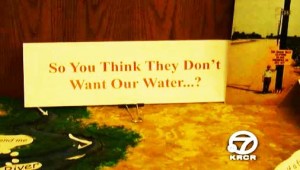
AquAlliance brought its visual display that tells the geographic story.

Environmental Water Caucus (EWC) Reduced Exports Plan

There are other real world solutions to California’s water woes that are much more cost-effective and environmentally friendly and can be produced more quickly than the Peripheral Tunnels and all its accoutrements. The Environmental Water Caucus produced the Responsible Exports Plan to provide a comprehensive picture of the alternative possibilities. Click here to view the Responsible Exports Plan (May 2013)

AquAlliance was a major contributor to the sections dealing with Northstate ground water.