New Questions Over California Water Project

AP NewsBreak
By Ellen Knickmeyer, Associated Press
August 12, 2016, 3:02 am ET

SAN FRANCISCO — Critics and a state lawmaker say they want more explanations on who’s paying for a proposed $16 billion water project backed by Gov. Jerry Brown, after a leading California water district said Brown’s administration was offering government funding to finish the planning for the two giant water tunnels.

Critics said the government funding described by the Los Angeles-based Metropolitan Water District on Thursday could run counter to longstanding state assurances that various local water districts, not California itself, would pay for Brown’s vision of digging twin 35-mile-long tunnels to carry water from the Sacramento River south, mainly for Central and Southern California. The $248 million in preliminary spending for the tunnels, which have yet to win regulatory approval, already is the topic of an ongoing federal audit. On Wednesday, state lawmakers ordered a state audit of the tunnels-spending as well.

On Thursday, state spokeswoman Nancy Vogel said that despite the account of the Los Angeles-based Metropolitan Water District, no money from the state’s general fund would be used finishing the current planning phase of the twin tunnels. However, opponents of the tunnels and a taxpayer group were critical Thursday, and Assemblywoman Susan Eggman, one of the state lawmakers behind this week’s audit order, asked the state Thursday for clarification.

“It’s a shell game,” said David Wolfe, the Howard Jarvis Taxpayers Association’s legislative director. “I think it comes back to the audit (request) yesterday: There are way more questions here than there are answers.”

The tunnels project is endorsed by Brown and by some politically influential water districts and water customers in Central and Southern California. Supporters say the tunnels would benefit the environment and offer Californians a more secure water supply. Opponents say they fear the state will use the tunnels to divert too much water from the Sacramento River and San Francisco Bay, harming Northern California and further endangering native species there.

Metropolitan and other water districts slated to get water from the tunnels have yet to commit to paying for them, out of uncertainty whether the massive spending would really bring them enough water to make the cost worthwhile. The same water districts also announced this year they would not pay to complete the current preliminary work on the tunnels unless the project first won regulatory approval.

On Thursday, a monthly report published by the LA-based water district on the tunnels project said, “the state has indicated that any additional funding needs to complete the planning phase will be provided by state or federal sources.”

After all that local water districts had spent on the project, including $63 million from his water district, “This is to be expected” that the state would use government money to close out planning, said Bob Muir, spokesman for the LA-based water district. He referred further questions to Vogel, the state spokeswoman.

Vogel said the state intended to pull money to finish the tunnels planning from user fees for an existing, half-century-old water network, the State Water Project.

Tunnel opponents, however, point to a measure state lawmakers passed in 2009 that they say bars the state from spending money on the tunnels until the water agencies that would benefit commit to paying for them.

“Project contractors pledged to pay for this project and they’ve used financial gimmicks to get around this obligation,” said Patricia Schifferle, an environmental consultant and longtime opponent of the proposed tunnels. “It raises questions as to where this money was suddenly found.”

———

Don Thompson contributed from Sacramento, Calif.

https://apnews.com/d35423c8a64b4f45a5155ebf1f87db0c/ap-newsbreak-new-questions-over-california-water-project


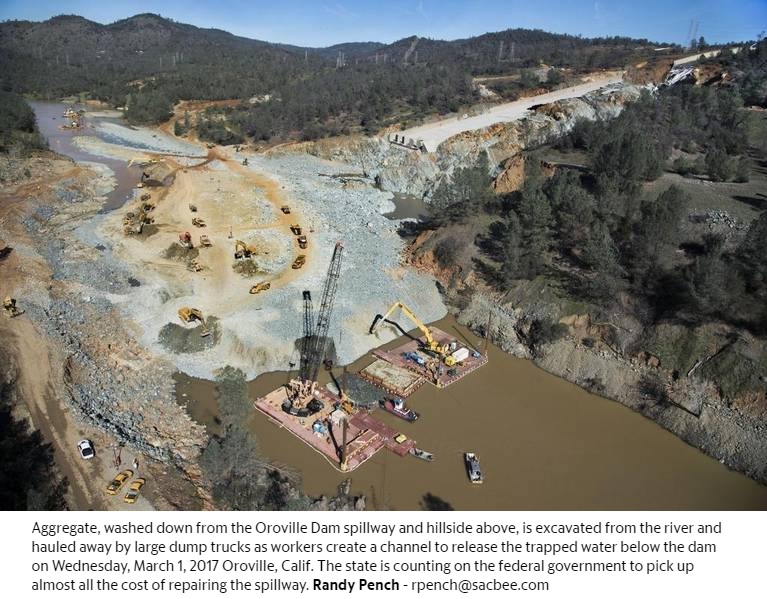
Fixing Oroville Dam will cost hundreds of millions. Who should pay the bill?

By Jim Miller, The Sacramento Bee, 4.25.17

Oroville Spillway Incident Overview

From “Oroville Spillway Incident” – California Department of Water Resources website:
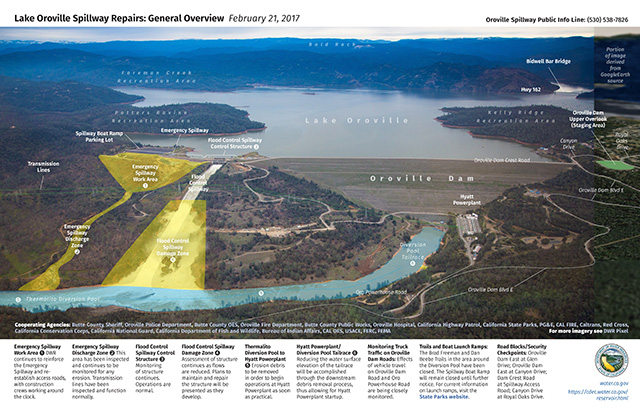
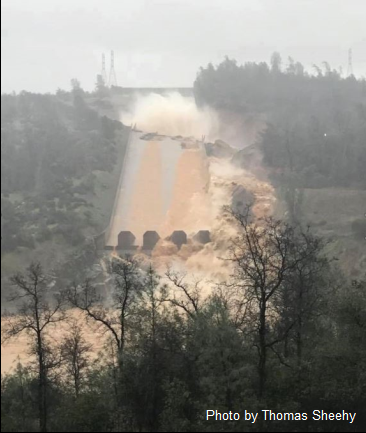
On February 7, erosion was noticed on the flood control spillway located adjacent to the Lake Oroville Dam. Department of Water Resources temporarily stopped outflow from the spillway to investigate the erosion. After testing and evaluation, outflow resumed from the flood control spillway to account for rising reservoir levels. Crews also began preparing for use of the emergency spillway…   View full DWR incident information.

California Governor Jerry Brown makes secret stop in Oroville

The governor was at the Department of Water Resources Wednesday (Feb. 22) in Oroville getting a briefing on the spillway repairs.

Action News Now reporter Sara Stinson was at the Department of Water Resources Wednesday afternoon where she saw Governor Brown. When she inquired about the governor’s presence, she was told “he was not there,” and was immediately escorted out of the tent briefing room and was informed only of spillway repairs.

This is what we do know, the DWR continues to release 60,000 cubic feet per second from the spillway.

Lake levels rose 853 feet, 48 feet below the maximum level of the reservoir. PG&E crews were able to fly steel poles by helicopter to replace power poles that were destroyed by the water outflow of the dam on Feb. 10.

Crews are also disassembling and removing two transmission towers, then will construct a permanent transmission line.

This has put a temporary flight restriction on all other helicopters working on the repairs.

But, 24-hours-a-day, regardless of weather conditions, 40 truckloads an hour have been delivering gravel, rocks and cement to continue construction.

There is still no word on the amount of damage caused to the emergency spillway.

“As long as we have water flowing down through that area we can’t get our experts in there to see how much that damage is so they can start formulating the plans to rebuilt or fix that spillway,” said Chris Orrock, DWR spokesperson.

The goal is to stop outflow to zero cfs on to the emergency spillway by this weekend to assess the damage.

DWR officials say they are looking at weather conditions and lake levels before they make the decision to stop all out flows.

The Butte County Sheriff Kory Honea has just confirmed Governor Jerry Brown was there visiting the Oroville Dam construction.

Click here to view story online.


Butte County Files Oroville Dam Emergency Petition

Emergency Petition to Correct Safety Deficiencies
and Establish a Public Safety Program

2.15.17: Butte County has filed an emergency petition requesting that the Federal Energy Regulatory Commission (FERC) immediately order the California Department of Water Resources (DWR) to establish a Public Safety Program that addresses the public safety lapses identified in filings with the Commission over the last 20 years, including providing for the necessary public safety and public services personnel, specifically trained in public safety and evacuation procedures. “Currently Butte County – a financially strapped county – bears the burden of providing services to the Project, at no cost to DWR, the contracting water districts, or the State of California. This must be remedied.”, the petition states.
Click here to view Emergency Petition.


Flash Flood Warning Feb. 12, 2017

BULLETIN – EAS ACTIVATION REQUESTED
Flash Flood Warning
National Weather Service Sacramento CA
435 PM PST SUN FEB 12 2017 

The National Weather Service in Sacramento has issued a
* Flash Flood Warning for…  A Dam Failure in…  South central Butte County in northern California…
* Until 415 PM PST Monday

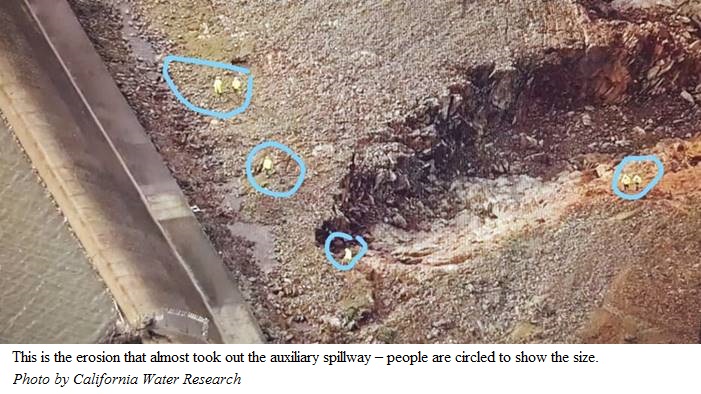
* At 419 PM PST,  Dam operators reported A hazardous situation is  developing with the Oroville Dam auxiliary spillway. Operation of  the auxiliary spillway has lead to severe erosion that could lead  to a failure of the structure. Failure of the auxiliary spillway  structure will result in an uncontrolled release of flood waters  from Lake Oroville.

In response to this developing situation, DWR is increasing water  releases to 100,000 cubic feet per second.

Immediate evacuation from the low levels of Oroville areas downstream is ordered. From Oroville to Gridley…low level areas around the Feather River will experience rapid river rises.

This is not a Drill. This is not a Drill. Repeat this is not a  drill. 

* Locations impacted include…  Oroville, Palermo, Gridley, Thermalito, South Oroville, Oroville  Dam, Oroville East and Wyandotte.

On 2/9/2017 10:50 PM, AquAlliance wrote:

AquAlliance

Emergency News

Any of you who are in Oroville or south or west of it prepare for an emergency and please help neighbors who have limited resources. Water coming into Oroville Reservoir is so massive and the spillway so damaged that it will be forced out the so-called emergency spillway tonight, which has never been tried before (down a hillside of trees, no cement).  Hours ago the inflow was approximately 185,000 cfs, and outflows 41,602 cfs. Even with the storm winding down, the warm temperatures will melt significant snow. Below are phone numbers and web sites of county offices of emergency services.

Butte County Office of Emergency Services – 538-7373 and http://www.buttecounty.net/oem/EmergencyEvents.aspx

Sutter County Office of Emergency Services – 822-4575 and https://www.co.sutter.ca.us/doc/government/depts/cs/es/cs_es_home

Yuba County Office of Emergency Services – 749-7520 and http://www.co.yuba.ca.us/departments/oes/

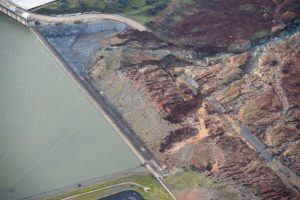
Photo illustrates the crater in the spillway:


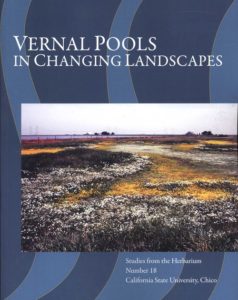
Vernal Pools in Changing Landscapes

18_Vernal_Pools_in_Changing_Landscapes_coverVernal Pools in Changing Landscapes is the newest book, Number 18, from Studies from the Herbarium, California State University, Chico.

Edited by
Robert A. Schlising & Erin E. Gottschalk Fisher
California State University, Chico
and
C. Matt Guilliams
Santa Barbara Botanic Garden

This book is a collection of articles derived from talks presented at the vernal pool landscapes conference, “Vernal Pools in Changing Landscapes: From Shasta to Baja,” convened by AquAlliance, in Chico, CA, April 14, 2014.

Information about this book and how to order is on the Friends of the Chico State Herbarium website: www.friendsofthechicostateherbarium.com/sfthm

Quit your bellyaching and restore the San Joaquin River

By Walt Shubin, 1.6.17
Special to The Sacramento Bee

A decade ago, environmentalists and the federal government agreed to revive a 150-mile stretch of the San Joaquin River, an ambitious effort aimed at allowing salmon to again swim up to the Sierra Nevada foothills to spawn. [Gary Kazanjian, The Associated Press]

Like other farmers in the San Joaquin Valley, I paid close attention last fall when the State Water Resources Control Board released a proposal that more freshwater flow from the Sierra stay in the San Joaquin River system on its journey to the Delta

The water board is proposing that a mere 40 percent of the flow in rivers feeding the San Joaquin – the Merced, Tuolumne and Stanislaus – make it to the Delta. Board Chair Felicia Marcus said action was long overdue to reverse loss of water quality and salmon runs.

It’s no surprise to me that Central Valley water districts, and parts of the Bay Area that get their water from the Tuolumne, raised a great hue and cry over this small step toward rational water use.

But not every farmer thinks the board went too far. In fact, this lifelong Valley farmer knows it hasn’t gone far enough to restore the balance and save the river.

Growing up in the Fresno area, I witnessed the unparalleled destruction of the San Joaquin River. I’m old enough to remember seeing San Joaquin spring-run Chinook salmon – once the largest run in the state – come up the river before dams were built and water diversion wiped out these amazing creatures.

I watched for decades as Friant Dam took every last drop of water from the San Joaquin upstream of its confluence with the Merced and left many miles of the state’s second-largest river completely dry. And I saw how farm runoff polluted with fertilizers and pesticides replaced the diverted water, representing the lion’s share of the river’s flow for long periods of the year.

These conditions led to the San Joaquin being named America’s Most Endangered River in 2014.

It’s not too late to revive the San Joaquin, her tributaries and their fisheries, but it will take more than returning 40 percent of the flow, which isn’t enough of a change from the status quo – only a third of the water now reaches the Sacramento-San Joaquin Delta. Scientists from fish and wildlife agencies, conservation groups and the water board agree that it will take between 50 and 60 percent of the river’s flow to do the job.

Residents of the San Joaquin Valley and the Bay Area, quit your bellyaching!

It’s clear that we are living beyond the limits set by Mother Nature. The same insatiable greed for water that devastated Valley rivers, water quality and salmon runs has led us to mine groundwater so intensely that some communities have trouble getting water, and the earth’s surface is rapidly subsiding. Requiring more water to remain in rivers will recharge our aquifers and make farming more sustainable in the long run.

In my younger days, I farmed 200 acres along the San Joaquin River, and I still farm 20 acres of organic raisins 4 miles from the river. I know from experience that water levels in my well and my neighbors’ wells rise when there’s more water in the river.

Everyone who uses the San Joaquin must play a part in repairing it. My fellow farmers must recognize that living in our area’s semi-arid climate imposes limits on how much we can irrigate. Bay Area residents and businesses that used money and smarts to reduce water use by more than 30 percent during the drought must recognize they can do even more by recycling water and storing it underground.

We Californians pride ourselves on being good environmental stewards. What better test of our commitment than to follow the science, learn to live within nature’s limits and make the San Joaquin a great river again?
Read more here.


Keats: California water projects rely on imaginary water

By Adams Keats, San Jose Mercury News. 12.27.16

keats-sjmn-12-27-16

Sen. Dianne Feinstein and San Joaquin Valley agribusiness would have us believe that bureaucratic red tape and blind adherence to environmental laws are holding back the State Water Project and the Central Valley Project, preventing water from being delivered to thirsty farms and cities.

Aside from pushing a false conflict between farms and fish, this thinking is flawed for another reason: It grossly overstates the amount of water capable of being produced by the State Water Project and the Central Valley Project.

The fundamental problem for water contractors dependent on Bay-Delta water supplies is not that the fish are getting too much water, but rather that the water isn’t there. Big Ag knows this full well because it baked this fact into the State Water Project contracts.
State Water Project contractors hold contracts for about 4.2 million acre-feet per year of project water (often referred to as “Table A Water”). Yet, as the Department of Water Resources admits, because much of the system was never built out — including several proposed dams that were taken off the table by Gov. Ronald Reagan when he protected several rivers as Wild and Scenic. So the State Water Project can only reliably produce between 2 and 2.4 million acre-feet per year. The difference is known as “paper water,” and the fact that the contracts are based on so much imaginary paper water is one of the main reasons the Bay-Delta ecosystem is collapsing.

The contracts are based on artificially inflated numbers because the “entitlements” set expectations high and put pressure on the state to actually deliver that amount of water.
These numbers present a false story of extreme hardship by the contractors, who even in the best years seem to only get half of the water they contract for. They put pressure on elected officials and provide false justification for bills like Feinstein’s.

Feinstein’s rider to the Water Infrastructure Improvements for the Nation Act calls for project officials to “provide the maximum quantity of water supplies” to contractors. More likely than not, that “maximum quantity” is going to start with the imaginary 4.2 million acre-feet.

Some years the State Water Project delivers the full 4.2 MAF. But the extra water comes from the mouths of the fish and the birds in the Bay-Delta ecosystem, from the hundreds of family farms in the Delta, and from California’s sustainable salmon fishing industry. These interests have proven to be a poor match against wealthy San Joaquin Valley agribusiness.

We need to rid the contracts of this paper water. As long as the system keeps promising double what it can deliver, there will never be enough water for anybody.
The state is currently negotiating with the water contractors for the extension of the contracts, which are set to expire starting in 2035. Although the latest drafts contain the paper water numbers, they can still be changed to finally bring the contracts out of fantasy land and into reality.

There is no good public policy reason to leave the inflated numbers in the contracts. It is time to break the cycle.

All water users – including birds and the fish that support the $1.4 billion salmon industry in California – are “entitled” to fair and sustainable access to what resources we have.
Gov. Jerry Brown and other state officials should demand the Table A amounts be reduced to reflect reliably deliverable water and set the State Water Project on the road to a functioning, sustainable future.

Adam Keats is a senior attorney at Center for Food Safety working on water supply and privatization issues. He wrote this for The Mercury News.

Trump’s water policy vague but a concern

ChicoER Editorial11.25.16, Chico Enterprise-Record: The upcoming Donald Trump presidency will reshape people’s lives in ways large, small or not at all, depending on each person’s circumstances. But we can think of nothing that can affect our entire region more than Trump’s position on water.

As is the case with many issues, it’s hard to know exactly where Trump stands.

The indications we get so far from the president- elect, however, have us concerned the Sacramento Valley could become a much larger version of the Owens Valley. The Sacramento- San Joaquin Delta region has good reason to worry as well.

Back in May, Trump made a campaign stop in Fresno. The drought has hit hard in the lower half of the state, much worse than up here. Trees are dying in the Sierra and farmland in the valley is being fallowed because of a lack of water.

Trump has a way of telling a crowd what it wants to hear, and since he was speaking to farmers in Fresno who see their livelihood at risk, he told them, “ There is no drought” and promised that if he were elected, he would “open up the water.”

Both of those statements are so incorrect and incoherent, it’s hard to know where to begin.

Rainfall totals prove that, particularly in the southern half of the state, there is indeed a drought. Rain gauges don’t lie. As for “opening up the water,” what does that mean? We have to assume Trump believes he can move water from a place that has it ( here) to a place that doesn’t (there).

Maybe as president he can, but federal courts have made it clear the federal government can’t just bypass the delta and harm the fragile ecosystem there without regard. Until he changes judges in the courts.

Meanwhile, the tired old fish vs. people argument is far too simplistic. The simple answer, however, always appeals to a politician.

When it comes down to that question, of course people are more important than fish. But if the delta and the lower stretches of the Sacramento became salty holding basins, if delta and north valley communities were sacrificed so that San Joaquin Valley farmers can continue to grow orchards in a desert, if north state water rights were stolen so a more populous area of the state could prosper, then it’s not a matter of fish vs. people. It’s a matter of people vs. people.

Maybe those were just words — campaign promises to get votes. But a couple of developments in the aftermath of Trump’s big win are telling.

First, Trump has appointed a former lobbyist for the San Joaquin Valley’s giant Westlands Water District to lead the transition team overseeing the Interior Department. That lobbyist, David Bernhardt, has been trying to convince Congress to take more water out of the delta and ship it south.

Second, Trump appointed Rep. Devin Nunes, R-Visalia, to his transition team. Nunes hosted a big fundraiser for Trump, so he was rewarded. Nunes is pushing a bill that would increase water deliveries to farmers south of the delta. That bill is supported by all House Republicans from California, including Doug La-Malfa, R-Richvale.

LaMalfa maintains the bill would preserve north state water rights and deliver more water to farmers in the San Joaquin Valley. Guess what loses? Fish, the delta ecosystem and the environment. No more releasing water at key times for endangered salmon. No more worrying about fish they think are insignificant, like the delta smelt. Farming comes first.

Even farmers up here, where there is abundant water, know they can’t pillage the environment in order to grow crops. If LaMalfa, Nunes, Trump and the rest of the beltway insiders don’t care, we hope local farmers do.

They need to keep a close eye on water developments, or our water rights will be the next to go.