Trump’s water policy vague but a concern

ChicoER Editorial11.25.16, Chico Enterprise-Record: The upcoming Donald Trump presidency will reshape people’s lives in ways large, small or not at all, depending on each person’s circumstances. But we can think of nothing that can affect our entire region more than Trump’s position on water.

As is the case with many issues, it’s hard to know exactly where Trump stands.

The indications we get so far from the president- elect, however, have us concerned the Sacramento Valley could become a much larger version of the Owens Valley. The Sacramento- San Joaquin Delta region has good reason to worry as well.

Back in May, Trump made a campaign stop in Fresno. The drought has hit hard in the lower half of the state, much worse than up here. Trees are dying in the Sierra and farmland in the valley is being fallowed because of a lack of water.

Trump has a way of telling a crowd what it wants to hear, and since he was speaking to farmers in Fresno who see their livelihood at risk, he told them, “ There is no drought” and promised that if he were elected, he would “open up the water.”

Both of those statements are so incorrect and incoherent, it’s hard to know where to begin.

Rainfall totals prove that, particularly in the southern half of the state, there is indeed a drought. Rain gauges don’t lie. As for “opening up the water,” what does that mean? We have to assume Trump believes he can move water from a place that has it ( here) to a place that doesn’t (there).

Maybe as president he can, but federal courts have made it clear the federal government can’t just bypass the delta and harm the fragile ecosystem there without regard. Until he changes judges in the courts.

Meanwhile, the tired old fish vs. people argument is far too simplistic. The simple answer, however, always appeals to a politician.

When it comes down to that question, of course people are more important than fish. But if the delta and the lower stretches of the Sacramento became salty holding basins, if delta and north valley communities were sacrificed so that San Joaquin Valley farmers can continue to grow orchards in a desert, if north state water rights were stolen so a more populous area of the state could prosper, then it’s not a matter of fish vs. people. It’s a matter of people vs. people.

Maybe those were just words — campaign promises to get votes. But a couple of developments in the aftermath of Trump’s big win are telling.

First, Trump has appointed a former lobbyist for the San Joaquin Valley’s giant Westlands Water District to lead the transition team overseeing the Interior Department. That lobbyist, David Bernhardt, has been trying to convince Congress to take more water out of the delta and ship it south.

Second, Trump appointed Rep. Devin Nunes, R-Visalia, to his transition team. Nunes hosted a big fundraiser for Trump, so he was rewarded. Nunes is pushing a bill that would increase water deliveries to farmers south of the delta. That bill is supported by all House Republicans from California, including Doug La-Malfa, R-Richvale.

LaMalfa maintains the bill would preserve north state water rights and deliver more water to farmers in the San Joaquin Valley. Guess what loses? Fish, the delta ecosystem and the environment. No more releasing water at key times for endangered salmon. No more worrying about fish they think are insignificant, like the delta smelt. Farming comes first.

Even farmers up here, where there is abundant water, know they can’t pillage the environment in order to grow crops. If LaMalfa, Nunes, Trump and the rest of the beltway insiders don’t care, we hope local farmers do.

They need to keep a close eye on water developments, or our water rights will be the next to go.


2016 AquAlliance Water Conference Set for Nov. 17-18

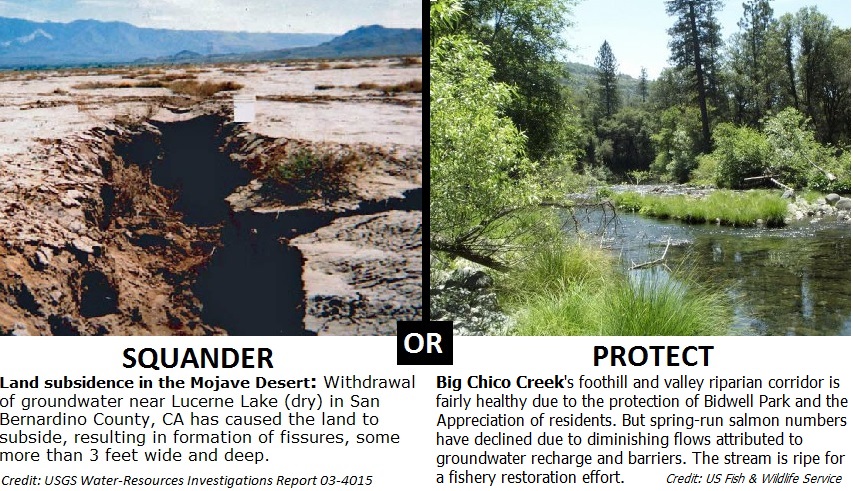
Water for Seven Generations: Will California Squander or Protect It?

AquAlliance will host its second, two-day conference on Thursday & Friday, November 17-18, 2016 to provide valuable scientific, legal, historical, political, and visionary information regarding California’s water. It will be held in the lovely concert hall at Sierra Nevada Brewing Company in Chico.

This conference will build upon the success of our 2012 inaugural water conference with a broad spectrum of topics and speakers. The objective is to provide information about California water that is typically missing from public presentations by water districts, state political leaders, consultants, and water agencies. AquAlliance intends to beam some sunshine into this politically charged topic that affects us all.

squander-or-protect

Conference Sections:

Day One: Day Two:
Science Science
Flow & Fish Owens Valley
Climate Water Transfers
Drought Panel The Sustainable Groundwater Management Act
Storage, Exports,Tunnels

Day One Keynote Speaker David Wegner is an expert on western water, endangered species, river restoration, the application and use of science, and adaptive management. He spent over 20 years with the Department of the Interior and was lead scientist for the Bureau of Reclamation’s environmental impact studies of Glen Canyon Dam. For 13 years he served as science director for the Glen Canyon Institute while establishing his own business, Ecosystem Management International, which specialized in the study of the effects of climate change on large landscapes, river basins and species both nationally and internationally.

REGISTER ONLINE NOW!
To register by mail: Click here for a printable Registration form.

Meet the California Couple who Uses More Water than Every Home In LA Combined

How megafarmers Lynda and Stewart Resnick built their billion-dollar empire.

ResnicksThe Resnicks are known for their billion-dollar-feel-good empire, including brands like Teleflora, Fiji Water, and Wonderful Pistachios (famously known for its “Get Crackin’” ad campaign). But most folks aren’t aware of how this Beverly Hills power couple is shaping California water rules to maintain and expand their empire.

In this feature, Mother Jones reporter Josh Harkinson explores the how the Resnicks’ Wonderful Company came to control more of California’s water in some years than the residents of Los Angeles and the Bay Area combined.

Read the full story at the Mother Jones website.

Thanks to Brian P Smith Public Relations, Oakland, CA – bpspr.com

Victory for the NorthState!

Faulty Delta Stewardship Council Plan and EIR Stopped

legal_victory6.23.16: We won! The Delta Stewardship Council’s poorly-crafted Plan to reduce reliance on water exports from the Delta, provide a reliable supply of water, and protect and enhance water quality from the Delta failed to pass legal muster. This is a tremendous victory in our ongoing efforts to protect the communities, businesses, and environment from the demands for water outside our region.

Background
AquAlliance asserted in public and written comments spanning years that the Plan and the Environmental Impact Reports (EIRs) failed to disclose and analyze the source of the water that the Plan sought to reach its lofty goals. It was clear to us that NorthState water was, as always, the target – especially our groundwater. AquAlliance and colleagues[1] also formally commented on the draft EIR in 2012 and a recirculated version in 2013 and then filed a state lawsuit in June 2013. Years passed dealing with numerous procedural issues until Sacramento Superior Court Judge Michael Kenny issued a substantive ruling in May 2016. In his ruling he determined that the DSC didn’t demonstrate reduced reliance on the Delta. How it impacted the EIRs’ legitimacy wasn’t too clear to attorneys on all sides of the litigation, so clarification was sought.

Today Judge Kenny explained his May ruling stating, “To be clear, the Delta Plan is invalid and must be set aside until proper revisions are completed. As Respondent itself argued previously, in light of an invalid Delta Plan, there is no proposed project, and consequently nothing before the Court to review under CEQA [California Environmental Quality Act]. The Court does not believe that piece-meal CEQA review is feasible under circumstances in which significant Plan revisions are required.”

The DSC must now go back to the drawing board as it has a legislative mandate to create a viable plan.[2] This ruling is also a stake in the heart of the state’s desire to build the Twin Tunnels, 40-foot diameter Tunnels that would drain the Sacramento River and NorthState aquifers,[3] diminish vital flows into the already stressed Delta, further stress native salmon runs, and destroy the economy and environment of the Sacramento Valley. The DSC Plan relied on the Twin Tunnels that are intended to benefit huge unsustainable corporate agribusiness on the west-side of the San Joaquin Valley.[4]

It is predictable that the DSC will appeal the ruling and AquAlliance and our colleagues will stay with the case with our good attorneys. But for now, celebrate!

——————————————————————————————————————————
[1] California Sportfishing Protection Alliance and California Water Impact Network
[2] 2009 Delta Reform Act, California Water Code § 85000 et seq.
[3] If the Twin Tunnels are built as planned with the capacity to take 15,000 cubic feet per second (“cfs”) from the Sacramento River, they will have the capacity to drain almost two-thirds of the Sacramento River’s average annual flow of 23,490 cfs at Freeport  (north of the planned Twin Tunnels). As proposed, the Twin Tunnels will also increase water transfers when the infrastructure for the Project has capacity. This will occur during dry years when State Water Project (“SWP”) contractor allocations drop to 50 percent of Table A amounts or below or when Central Valley Project (“CVP”) agricultural allocations are 40 percent or below, or when both projects’ allocations are at or below these levels (EIS/EIR Chapter 5). With this Project, North to South water transfers will be in demand and feasible.
[4] An excellent 2012, 14-minute video by Salmon Water Now! provides the viewer with a succinct understanding of the politics of water and greed in California (www.youtube.com/watch?v=QG0WMDpv6_I).

Photo courtesy of http://thetruthaboutplas.com

Trump lives in fact-free world on our drought

ChicoER Editorial

Thanks to the Chico Enterprise-Record for speaking out on our critical North State water issues! Below are some excerpts from the editorial — to read it in full, please click: Trump lives in fact-free world 6.6.16

… Talking and pandering to a group of Central Valley farmers, who never saw someone else’s water they didn’t like, Trump declared: 1) “There is no drought,” and 2) “Even the environmentalists don’t know why” a minimum amount of water has to flow into the San Joaquin-Sacramento River Delta to protect the health of the waterway.

These are fact-free declarations.

“There is no drought” is just goofy. … Trump must know we haven’t gotten much rain. What he really means is that California has plenty of water for farmers — if it just drains its rivers dry, and stops worrying about the wildlife and ecosystem of the delta. Who cares if it turns into a salt-water inlet? Who cares if you sacrifice fisheries in favor of people who farm in a seasonal desert?

Environmentalists (and lots of business leaders and, oh, most educated Californians in general) know precisely why that’s not a good idea. All of the reputable scientific studies of delta have the same conclusion: The estuary needs more water, not less, to stay healthy. And if it turns into a dying waterway, it will no longer be a good source of water for places like the Bay Area, which would put more stress on the overtaxed water delivery system.

… a National Academy of Sciences report on the delta … concluded, like the others, that continued unsustainable water diversions are a major factor driving salmon and other native fish in the delta to extinction. And as rivers upstream are sucked dry and no rain replenishes them — what happens then?”

Stewardship is not a concept in the Trump lexicon. But really — is a dead delta what will make America great?

Glenn water district backs down from plans for five new wells

by Heather Hacking, Chico Enterprise-Record, 4.9.16

Willows: Plans are off the table for now for Glenn-Colusa Irrigation District to drill five new wells as a backup water supply during dry times.

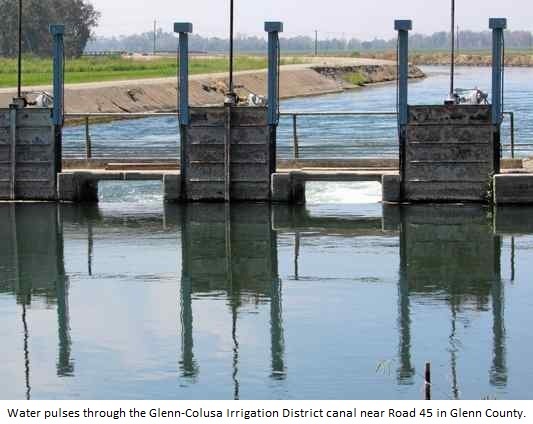
The surface water district provides water to more than 1,000 farmers in the Sacramento Valley, for a total of about 175,000 acres. The plans for the wells have been on paper for a few years, and two public meetings were held to accept public comment.Glenn wells 4.9.16

At a public meeting in Ord Bend last July, the majority of people who spoke said they were strongly against the plan for five new wells for the district, which has senior water rights along the Sacramento River. Speakers were also critical of five wells previously drilled by the district.

In August of last year, the Glenn County Board of Supervisors was knee-deep in discussions about whether to pass a moratorium on drilling new wells. The board passed a temporary ban on new wells, including any Glenn-Colusa would have planned. That well moratorium has been extended.

At the Thursday meeting of the Glenn-Colusa board members, it was made official that the idea for the new wells would be taken off the table.

Barbara Vlamis of Chico’s www.aqualliance.net believes pressure by her group and others helped dissuade Glenn-Colusa from moving ahead with the new wells.

Vlamis has been tracking operations, water transfers and future plans of the district for decades. When it came time to submit public comments she submitted 37 pages of legal arguments against the wells. The intention was that if the plans moved forward, she and other groups planned to file a lawsuit based on the California Environmental Quality Act.

Back in July 2015, the Butte County Board of Supervisors sent a letter to Glenn-Colusa, voicing concerns about whether those wells could impact groundwater levels in Butte County, just across the river.

“The county is concerned about the use of the wells for other purposes, such as a future groundwater substitution water transfers, which would move groundwater outside of the region,” the letter stated, among other concerns.

Glenn-Colusa leaders said the wells were not intended for transfers, but would be used to help growers when there were water shortages and to help reduce Sacramento River diversions when river water was needed for migrating fish, among other benefits.

This week the district decided at its board meeting to put the plans for the wells on the back burner.

This will leave more time to work on a water resource plan, said Glenn-Colusa manager Thad Bettner.

Many water issues are happening simultaneously, including ongoing issues facing water supply and fish populations and questions of secure water supply.

Having a water resource plan will put the water district in better position for the Groundwater Sustainability Act, which requires regional planning for groundwater use, Bettner said.

Glenn-Colusa will be working with Sacramento Valley cities and other water groups when state-mandated new groundwater programs are established over the next several years.

“We still see that the wells are necessary,” Bettner said.

The plans that have been developed so far can be picked up in the future, he said.

With more water in Lake Shasta, and other water issues very prevalent, Bettner said the board decided to work on issues that have risen to the top of the stack.

Vlamis said she believes the recent decision has more to do with “overwhelming public opposition” to the idea for the new wells.

“There were significant players lining up to litigate because there were major holes in the project.”

She called the backtrack on the plans a “success under CEQA.”

Contact reporter Heather Hacking at 896-7758.

The drought’s silver lining: It’s forced us to confront the Golden State’s scarcity of water


Bob SpeerGuest Comment 


by Robert Speer
Chico News & Review,
11.12.15 


Crises have a way of compelling change. 
California’s four-year drought has forced us to confront, once and for all, the scarcity of the state’s most precious resource, its water.

A consensus is emerging among Northern Californians that, unless we act now, we may see our water, including groundwater, drained for the benefit of users south of the Sacramento Valley.

The threat has three main sources: the federal Bureau of Reclamation, whose 10-year plan would send 600,000 acre-feet of water south annually for a decade; the state of California, which wants to build two huge tunnels in the Delta to send more Sacramento River water south; and the Glenn-Colusa Irrigation District, which wants to sell surface water south and replace it with groundwater.

Local orchardists forced lately to dig deeper wells understand what’s at stake. They’ve seen what has happened in the over-pumped San Joaquin Valley, where aquifers have collapsed and the ground subsided, sometimes by several feet.

Who, we might ask, is working to protect our groundwater? Not our state legislators, who know where the votes and campaign funds are. Not our congressional delegation, for the same reasons. And not Gov. Brown, who seems determined to build his terrible tunnels.

Defending the North State against these powerful forces are several grassroots organizations such as the Butte Environmental Council, the Sacramento River Preservation Trust and AquAlliance. Of the three, only AquAlliance is focused strictly on water. Led by the redoubtable Barbara Vlamis, its only paid staff member, and with the help of a cadre of volunteers, it is putting up fierce resistance in the courts.

It was AquAlliance that forced the feds to come clean about their 10-year plan for water transfers. It was AquAlliance that sued to stop state water agencies from allowing water-quality-law violations injurious to Sacramento River salmon. And it is AquAlliance that is leading the legal challenge to GCID’s plan to put in five massive new production wells designed to free up surface water for sale.

That’s a lot for such a small group to do. It needs your help, mostly to pay for legal expenses and consultants. Please, go to www.aqualliance.net and donate.

Click here to view article at at The Chico News & Review website.

Tunnels don’t add up, now we know why

Editorial graphic3.20.16, Modesto Bee: For years now, Gov. Jerry Brown has been telling us that he will save the Sacramento-San Joaquin Delta – the greatest fresh-water estuary on this side of the continent – by taking water out of it.

Environmental scientists have hustled out to make his case. Wildlife experts have joined the “Oyez” chorus. And state water managers insist it is our only option.

Among the biggest and most enthusiastic backers is the largest irrigation district in the world, Westlands Water District, and the largest urban water supplier in the world, Metropolitan Water District. Met has even bought four islands to facilitate the tunnels. They keep a public relations firms on call to answer any negativity (like this).

Yet, to many of us poor, unlearned Valley dwellers it just doesn’t make sense. How can you save a water system by diverting major portions of its water before it ever gets to the Delta?

Thank goodness Westlands is here to clear up any confusion. We just need to apply a “little Enron accounting,” in the words of an unnamed Westlands employee quoted in a recent Securities and Exchange Commission fraud charge. That’s right, fraud charge; we’ll get back to that in a moment.

First, recall Enron. That was the Texas energy company that convinced California’s gullible legislators to deregulate electricity in 1996. Within a few months, the company began “gaming” the market by artificially limiting supply during heat waves. The company made hundreds of millions in dishonest profits as prices skyrocketed and blackouts rolled across California.

One trader sang “Burn, baby burn” as prices spiked. Another spoke admiringly of a co-worker, saying “He steals money from California to the tune of about a million.” And who can forget the Enron employee who laughed at the thought that “Grandma Millie” would want her “(expletive) money back.”

Those employees could mock our misery because they thought no one would hold them accountable for their “Enron accounting.” But that wasn’t true. Enron folded and some of the crooks at the top went to jail.

Westlands didn’t do anything comparable to the Enron scandal, but the nation’s largest water district did get caught lying to investors. Using what an unnamed Westlands executive called “a little Enron accounting,” the district maximized returns for water customers while misleading those who bought its bonds in 2012.

The Securities and Exchange Commission fined Westlands $125,000 to settle the charges last week. It also fined Westlands general manager Thomas Birmingham $50,000.

“Issuers must be truthful with investors,” said Andrew J. Ceresney, Director of the SEC Enforcement Division.

Because Westlands wasn’t truthful, the fines were appropriate if somewhat low (they were the highest ever for a public agency).

And that brings us back to the tunnels. How can we trust anything untruthful Westlands says? How do we keep faith in Westlands’ partners – Metropolitan and Gov. Jerry Brown?

As we’ve pointed out repeatedly, if you divert major portions of the Sacramento River under the Delta, the only way to “save” the Delta is to increase the flows from the much-smaller San Joaquin River into the Delta. To do that, the state will have to take more of the flows from the Merced, Tuolumne and Stanislaus rivers. The tunnels are nothing less than a water grab, and it’s our water they’re grabbing.

Remember feeling victimized by Enron’s dishonest accounting? The tunnels only make sense with more “Enron accounting.” If they’re built, forget getting our water back.

Fine should put a halt to twin tunnels

3.18.16, Contra Costa Times: Give it up, governor.

Gov. Jerry Brown is counting on the Westlands Water District to be one of the major financial backers of his $15 billion Delta tunnels, easily the largest public works project in U.S. history.

It’s time he dumped the whole notion, given last week’s admission by Westlands general manager that the nation’s largest water district got caught cooking the books with “a little Enron accounting.”

The Securities and Exchange Commission was not amused. The SEC leveled a $125,000 fine on Westlands to settle charges that it misled investors by faking its financial records in connection with a 2012 bond issue.

It’s the largest settlement ever for a case involving a municipal bond agency, and it raises major questions about Westlands’ credibility.

If Westlands General Manager Thomas Birmingham has an ounce of integrity he would immediately resign. Instead, it appears he will pony up the SEC’s separate $50,000 fine for his role in the wrongdoing and keep his nearly $400,000-a-year job.

Westlands’ penchant for playing fast and loose with investors normally wouldn’t matter all that much to Bay Area residents. But the Santa Clara Valley Water District will decide sometime within the next year if it wants to jump into bed with Westlands and Southern California’s Metropolitan Water District as major investors in the twin tunnels project.

This is just one more reason it shouldn’t.

The plan is nothing but a massive water grab by desperate Central Valley farmers and Southern California’s thirsty urban dwellers.

The project won’t produce a drop of new water for California while ratepayers will bear the brunt of a $15 billion project with costs that could perhaps double or triple, given the typical overruns on state projects.

Westlands’ settlement with the SEC includes no admission of wrongdoing, but it’s easy to see why it was hit with the big fine. In 2012, Westlands sought a $77 million bond sale. As a part of that transaction, it needed to tell bond buyers that it would maintain a 1.25 percent debt service ratio cushion, as it had with previous bond deals.

Except, in 2010, drought conditions made it impossible for Westlands to collect the revenues needed to do so. The right thing to do would have been to either admit the shortfall to potential investors, which would have raised borrowing costs, or raise rates to farmers by 11.6 percent to make up the difference. Westlands instead took money from accounts dedicated to other commitments to make it appear that all was well.

The twin-tunnel project was a bad idea from the outset. The latest revelation should end any thoughts by Gov. Jerry Brown or any local district of going into business with Westlands.

Federal SEC Charges Westlands Water District with ‘Enron Accounting’

by Dan Bacher, Daily Kos.com

3.10.16: Westlands Water District, considered to be the “Darth Vader” of California water politics by leaders of fishing groups, Indian Tribes and environmental organizations, is in boiling hot water with the federal Securities and Exchange Commission (SEC).
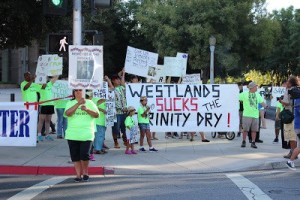
Westlands protest

Hoopa Valley Tribe members protest Westlands Water District’s salmon-killing policies in Fresno, August 2013.

The SEC yesterday charged California’s largest agricultural water district, situated on drainage-impaired land on the west side of the San Joaquin Valley, with “misleading investors about its financial condition as it issued a $77 million bond offering,” according to a statement from the Commission.

The water district has been one of the biggest promoters of the Governor Jerry Brown’s California Water Fix to build the Delta Tunnels until recently when they told FOX News in Los Angeles that they can no longer afford to pay for the project, a government boondoggle that could cost up to $67 billion.

“Birmingham jokingly referred to these transactions as ‘a little Enron accounting’ when describing them to the board of directors, which is comprised of Westlands customers,” the SEC reported.

According to the SEC’s order instituting a settled administrative proceeding:

Westlands agreed in prior bond offerings to maintain a 1.25 debt service coverage ratio, which is a measure of an issuer’s ability to make future bond payments.

Westlands learned in 2010 that drought conditions and reduced water supply would prevent the water district from generating enough revenue to maintain a 1.25 ratio.

In order to meet the 1.25 ratio without raising rates on water customers, Westlands used extraordinary accounting transactions that reclassified funds from reserve accounts to record additional revenue. 

When Westlands issued the $77 million bond offering in 2012, it represented to investors that it met or exceeded the 1.25 ratio for each of the prior five years.

Not only did Westlands fail to disclose that wouldn’t have been possible without the extraordinary 2010 accounting transactions, but also omitted separate accounting adjustments made in 2012 that would have negatively affected the ratio had they been done in 2010. 

Had the 2010 reclassifications and the effect of the 2012 adjustments been disclosed, Westlands’ coverage ratio for 2010 would have been only 0.11 instead of the 1.25 reported to investors.

Birmingham and Ciapponi improperly certified the accuracy of the bond offering documents.

The SEC said Westlands agreed to pay $125,000 to settle the charges, making it only the second municipal issuer to pay a financial penalty in an SEC enforcement action.

Birmingham agreed to pay a penalty of $50,000 and Ciapponi agreed to pay a penalty of $20,000 to settle the charges against them.

“The undisclosed accounting transactions, which a manager referred to as ‘a little Enron accounting,’ benefited customers but left investors in the dark about Westlands Water District’s true financial condition,” said Andrew J. Ceresney, Director of the SEC Enforcement Division.  “Issuers must be truthful with investors and we will seek to deter such misconduct through sanctions, including penalties against municipal issuers in appropriate circumstances.”

The SEC’s order finds that Westlands, Birmingham and Ciapponi violated Section 17(a)(2) of the Securities Act of 1933 and must cease and desist from future violations. 

You can read the SEC decision here: http://www.sec.gov/litigation/admin/2016/33-10053.pdf

In response to the SEC action, Barbara Barrigan-Parrilla, Executive Director of Restore the Delta, said, “Westlands Water District has been fined for doing Enron-style accounting on the sale of water bonds in 2012. Portions of those bonds were used to finance planning of the Delta tunnels project.”

“Westlands leadership, however, recently told Fox News in Los Angeles that they can no longer afford to pay for the Delta tunnels project. Clearly, they are no longer in a position to sell bonds for paper water — because the Delta tunnels will not provide any new water to water exporters,” she said.

She said the vote on Tuesday, March 8 by to Metropolitan Water District (MWD) of Southern California to purchase Delta islands in order to have a staging site for construction of the Delta Tunnels “indicates that water exporters are so desperate to push the project through that they will continue to push it forward even without a viable funding plan.”

“The question now is if Southern California and Santa Clara Valley ratepayers are willing to pay not only their share for dry tunnels, but for Westlands growers as well,” Barrigan-Parrilla concluded.

Tom Stokely of the California Water Impact Network noted that the SEC action “reminded me of a transcript from a Westlands board meeting where Birmingham, in response to a question, said the district would declare bankruptcy and default on bonds for BDCP, the predecessor to the California Fix,  if necessary, and the landowners would not be held financially responsible.”

The transcript from the Westlands Water District Board meeting of January 15, 2014, states:

Q: If the District goes broke, will the bondholders not come back [and go after the Westlands landowners?]. 

A: The security on the bonds is the [Westlands] district’s revenue, not the landowner’s land. In a worst case, we file for bankruptcy. That’s what the District could do. The landowners’ land is not security.”

You can read the transcript of the meeting here: https://www.c-win.org/webfm_send/434

Stokely said that it is clear from the SEC action, as well as from the Westlands board meeting transcript, that  “anybody who would buy bonds through Westlands for the Delta Tunnels or anything else is taking a huge risk.”

“Why would the Metropolitan Water District and Santa Clara Valley Water District want to partner with an entity like Westlands that can’t be relied upon to tell the truth or pay off their debt?” asked Stokely. “The federal government has appoved a court settlement that would forgive Westlands $375 million in interest-free debt they owe the federal government for their share in the construction of the Central Valley Project facilities that deliver their water. It’s clear that urban ratepayers of California would have to pick up Westlands’ tab for the Delta Tunnels.”

Westlands has sued the federal government over the past several summers in unsuccessful attempts to stop supplemental releases from Trinity Reservoir to prevent a massive fish kill on the lower Klamath River, prompting protests by members of the Hoopa Valley, Yurok, Karuk, Winnemen Wintu and other Tribes in 2013 and 2014 against Westlands’ litigation.

“Central Valley water users have made untold billions of dollars at the expense of Trinity River salmon and communities,” said  Danielle Vigil-Masten, then the Chairwowman of the Hoopa Valley Tribe, before a protest organized by the Tribe in Fresno in August 2013. “The greed and aggression represented by this lawsuit and the hypocrisy of the plaintiff’s exploitation of environmental protection laws both stuns and saddens us.” (http://www.dailykos.com/story/2013/8/20/1232633/-Hoopa-Valley-Tribal-Members-Protest-Westlands-Lawsuit.)

A call to the Westlands Public Affairs Office regarding a comment on the SEC decision has not yet been returned.

According to the New York Times, “Responding on Thursday to the settlement, Fitch Ratings placed a negative ratings watch on $193.6 million in Westlands debt, indicating a higher chance that those AA bonds would be downgraded. It also placed a negative watch on $29.8 million in bonds issued by the San Luis and Delta-Mendota Water Authority, a collection of California water districts whose leading member and partial financier is Westlands.” (http://www.dailykos.com/stories/2016/3/10/1499271/-Federal-SEC-Charges-Westlands-Water-District-for-Enron-Accounting )