Those “Fracking” Facts, Jerry Brown’s Lost Colusa Oil Wells Found

3 Oil/Gas Wells Listed on Brown’s Family Homestead
by Red Smith

2.10.16: Recently California Governor Jerry Brown came under fire for the use of public funds to conduct a geological survey on his family property in Colusa County. The Governors office immediately and vehemently denied any wrong doing, claiming the Governor didn’t use any services not readily available to any other California resident. However former head of the State of California Oil, Gas and Geothermal (Department of Conservation) Steve Bohlen denied Californians would have similar access as the Governor, in response well over 250 Californians requested identical surveys of their personal property, to date zero of those requests have been acknowledged. Furthermore Jennie Catalano, a mapping specialist for the California Department of Conservation, emerged stating she faced retaliation after complaining about being required to do personal work for Brown. Jennie Catalano has filed a whistleblower case over the incident.
BrownWellOverlayBrown claims his request was to satisfy his interest in the history and geology of his family’s land, however many, especially those in the California Republican Party, claim the report focused primarily on oil and gas deposits. Republicans are calling for a full investigation. Assemblywoman Shannon Grove (R-Bakersfield) stated “The governor’s actions appear to be a clear violation of well-known state law prohibiting the use of public resources for personal gain. There will need to be an investigation to ensure the facts are brought out.”

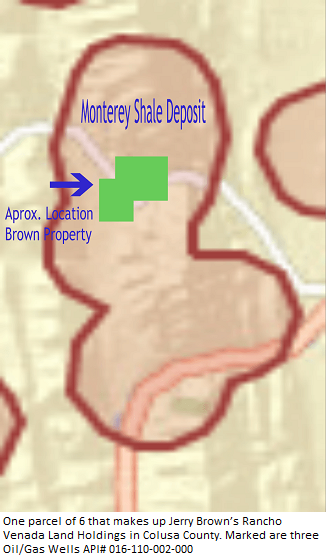
In conversation with the Governors office late last year, Gubernatorial staff stated that no shale oil or natural gas deposits were found to be present on the property. This statement is proving to be categorically false information and considering the source of the contrary evidence, a bald faced lie. There is in fact a large deposit of shale oil on the Rancho Venada property according to USGS mapping of shale deposits.
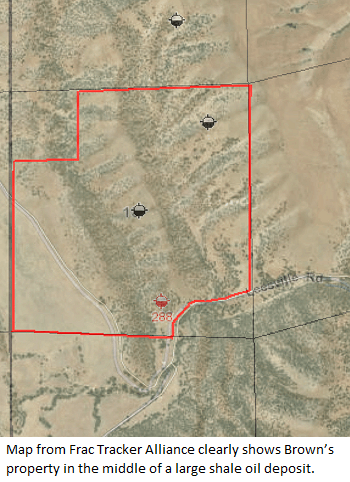
BrownshaleGovernor Brown has continually denied the existence of oil or gas wells on the Rancho Venada property, however according to maps from the California Department of Conservation (see map top right) three wells do exist on the Governor’s property and have for decades. The first well (from top to bottom) is listed as Smith & Vickers Well#1 a plugged production gas well, API: 01100287. The second well is listed as E. & G. Products Well#1 an idle production gas well, API: 01100286 . Well 3 is listed as Mountain House Oil Company Well#5 an idle production Dry Gas Well, API: 01100288 .


Well information compiled from recorded documents of California State Mining Bureau Department of Petroleum & Gas and State of California Natural Resources Oil and Gas Division

Smith & Vickers Well#1 is reported to have been abandoned on May 12th, 1931. This well is reported to have drilled to a depth 1027′ and never produced oil, however it did strike fresh water at a depth of 302′ to 308′ producing 8 barrels a minute of water. No oil sands were present. The hole was sealed with a 10′ cement plug.

  1. & G. Products Well#1 is reported abandoned May 20th, 1938. Apparently the oil derrick and pumping equipment burned and drilling never resumed. The well is reported to have been drilled to a depth of 148′ where it began to produce a mixture of oil and saltwater amounting to roughly a half gallon of oil a minute. Shale oil, oil sands and blue shale were encountered prior to termination of operations. The hole is currently untapped and idle.

Mountain House Oil Company Well#5 is reported as abandoned on December 31st, 1931. The well was drilled to a depth of 1322′ where it struck sand shell deposits and blue shale. A natural gas deposit “in commercial quantities” was discovered at a depth of 1042′. The hole is currently listed as capped with a small pipe and idle.
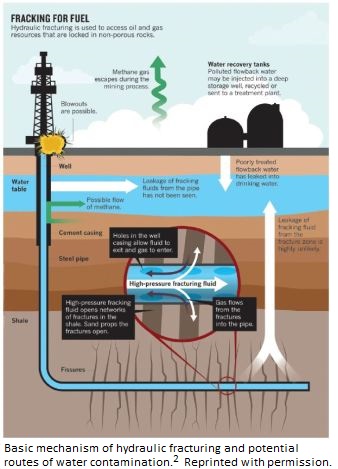
Fracking1Regarding the E. & G. well and the Mountain House well 1930’s drilling technology would not have allowed for viable petroleum production from those sand and shale deposits, however due to new drilling techniques, namely “fracking”, those two wells now stand to be potentially, extremely lucrative if exploited. Fracking however requires vast amounts of water to pump into the wells in conjunction with sand and chemicals to fracture the shale deposits thereby releasing the trapped oil or gas deposits. Rancho Venada is a notably parched section of land in a historically dry region and would be hard pressed to accommodate the needed hydro-flow capacity to begin a fracking project.

However in November of 2015, in direct conversation with a local in ground resources infrastructure company the Shasta Lantern confirmed that wells had in fact recently been drilled on the Rancho property. It is believed a total of 9 wells, at least 6 of which were water wells, were drilled in the last quarter of 2015. These wells are thought to be potentially drilled using tax payer funded agricultural grants for livestock wellheads, however no livestock is believed to be present on the property. This information was fact checked by Agenda 21 radio.

In further research the Shasta Lantern has discovered there is a potential as well for geothermal development in the area of the Rancho Venada property. In a radical new procedure headed up by Berkeley-Livermore Labs known as Induced Seismicity it may be possible to ” revitalize” defunct geothermal vents not hot enough to produce the required steam for power production. This project is believed to be headed by Steve Bohlen, the former head of the California Conservation Department Oil, Gas and Geothermal Division, who resigned last year amidst the Jerry Brown Survey Scandal and returned to his former employer Berkeley-Livermore.

However in November of 2015, in direct conversation with a local in ground resources infrastructure company the Shasta Lantern confirmed that wells had in fact recently been drilled on the Rancho property. It is believed a total of 9 wells, at least 6 of which were water wells, were drilled in the last quarter of 2015. These wells are thought to be potentially drilled using tax payer funded agricultural grants for livestock wellheads, however no livestock is believed to be present on the property. This information was fact checked by Agenda 21 radio.

In further research the Shasta Lantern has discovered there is a potential as well for geothermal development in the area of the Rancho Venada property. In a radical new procedure headed up by Berkeley-Livermore Labs known as Induced Seismicity it may be possible to ” revitalize” defunct geothermal vents not hot enough to produce the required steam for power production. This project is believed to be headed by Steve Bohlen, the former head of the California Conservation Department Oil, Gas and Geothermal Division, who resigned last year amidst the Jerry Brown Survey Scandal and returned to his former employer Berkeley-Livermore.

Induced Seismicity is a process of injecting water into super heated vents to produce “micro-quakes” to fracture bedrock formations and open those vents to exploitation. A similar project is already underway at the nearby Geysers Geothermal field operated by CalPine Power. At this time 20 million gallons a day of reclaimed waste water is pumped from Santa Rosa and Lake County sources to the CalPine plant for injection into thermal vents to maintain steam pressure for power production. The vents near and potentially on the Rancho property are akin to those of the Geyser field as in they could be exploited for power production if they had access to a reliable water source.
SitesRes1

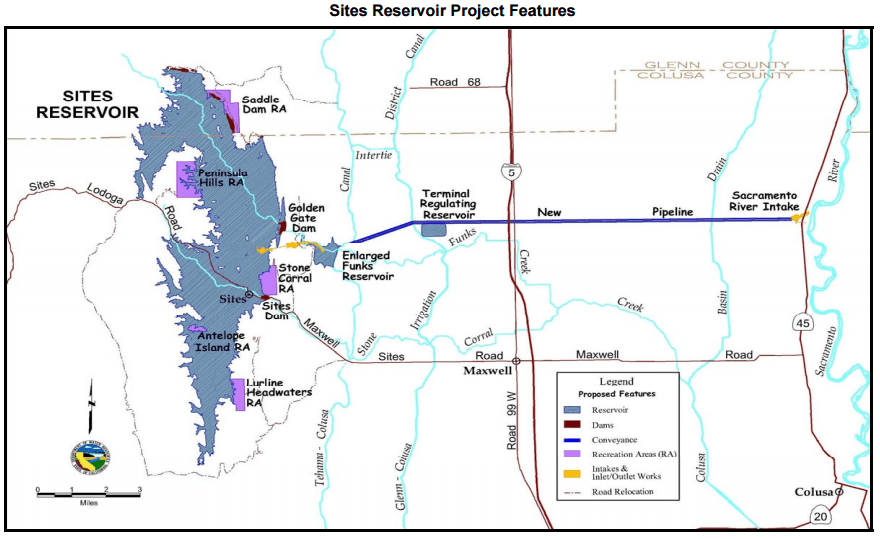
Enter California’s recent $7.5 Billion water Bond and the Sites Reservoir Project. In 2015 the water bond was overwhelmingly passed, minus support of the 10 most Northern Counties of California none of which voted to pass the bond, to ostensibly create new water storage areas for drought relief. Sites Reservoir is the at the top of the list of those projects, purportedly for agricultural use. Yet in discussion with a local hydrologist and engineer he claims that the Sites Reservoir design and capacity is incompatible and impracticable for agricultural irrigation use.

First off Sites Reservoir does not represent a true water storage reservoir as it relies on pumping water from the Sacramento River through miles of canals to sustain the water level. This is a diversion of water, not new storage. Furthermore due to the distance traveled to reach the reservoir the captured water could see as much as 50% surface evaporation.

Secondly due to the shallowness of the reservoir and the manner of water capture it will be a “warm bodied reservoir” prone to toxic algae blooms making it totally unfeasible for recreational or irrigation usage.

However our source did state that Sites Reservoir did have one big plus. As the reservoir is filled it will begin to saturate the surrounding areas, especially down stream of the reservoir, and raise the water table and create a new aquifer. It just so happens, mere miles, downstream from the Sites Project is Jerry Brown’s Rancho Venada Property. Although the Sites Reservoir appears to be inadequate for its stated purpose of water storage and irrigation, it is in a prime location and of sufficient capacity to feed the interests of energy companies hungry for water to frack oil, gas and geothermal deposits in the area.

In conclusion some facts have become quite clear. Jerry Brown did in fact use public funds to conduct a resource survey of his land, in all probability to examine potential natural resource exploitation. These services are not readily available to any California citizen as claimed by Brown and staff. Despite claims to the opposite, wells including gas and oil, do exist on the Rancho Venada property. At least two of those wells have good potential to be exploited for commercial fossil fuel production if given access to the needed water supplies. In direct contradiction to Jerry Brown’s staff claims that no substantial oil deposits were located on the ranch, shale oil deposits exist in great abundance, in fact the ranch is in the middle of a potential lake of shale oil. Upon further neutral examination, the Sites Reservoir is a poor model for it’s stated purpose of irrigation and water storage. It does however provide ready access to a sustainable supply of water to interests, including possibly Governor Brown and his property, wanting to exploit the area by fracking.

There is one problem with Governor Brown’s attempt to sweep this situation under the rug as nothing more than an interest in family history. Facts Jerry, those “fracking” facts.

View at Shasta Lantern website: https://shastalantern.net/2016/02/those-fracking-facts-jerry-browns-lost-colusa-oil-wells-found/
Twin Tunnels Protest 1.5.16

Protest of CSPA, C-WIN & AquAlliance of the Petitions “Requesting Changes in Water Rights of the Department of Water Resources and US Bureau of Reclamation of the California Waterfix Project”

Click here to view the Protest document. (Yellow highlights show our specific section, although we contributed to other areas.)

No tunnels symbolThis protest demonstrates how AquAlliance is again representing the NorthState in a way that local governments are not. Butte County was the most possible entrant into the fray fighting the Twin Tunnels before the State Water Resources Control Board. Here was the response to our questions about their involvement:

The County is going to continue to be actively involved in the WaterFix Project especially through the SWRCB proceedings. But we will not be putting in a notice to appear or to provide testimony for the April 7th hearing. I expect that we will be commenting at various points along the way.”

They will comment without creating legal standing. What this means is that they are not formally protesting the permits or planning to try to stop the Tunnels as are AquAlliance and our colleagues.


Farmers Try Political Force to Twist Open California’s Taps

New York Times, 12.31.15:

A powerful article about the political clout of Westlands Water District:

“A water utility on paper, Westlands in practice is a formidable political force, a $100 million-a-year agency with five lobbying firms under contract in Washington and Sacramento, a staff peppered with former federal and congressional powers, a separate political action committee representing farmers and a government-and-public-relations budget that topped $950,000 last year. It is a financier and leading force for a band of 29 water districts that spent at least another $270,000 on lobbying last year. Its nine directors and their relatives gave at least $430,000 to federal candidates and the Republican Party in the last two election cycles, and the farmers’ political action committee gave more than $315,000 more.

“Aggressive, creative and litigious … the district has made enemies of environmentalists, rival politicians and other farmers whose water it has tried to appropriate. But it has also repeatedly made deals and won legislative favors to keep water flowing to itself and to farms across the San Joaquin Valley, California’s agricultural heartland.”

Click here to read the full article.

Sites Reservoir: Different Views

Sites looking southHere are some very different view on the benefits of the proposed $6.3 billion Sites Reservoir on the west side of the Sacramento Valley.


The Good (AquAlliance agrees):

The Bad (AquAlliance disagrees):

Public Records 1, GCID 0


Score one for AquAlliance!

It started back on October 7, 2014, when AquAlliance attended Glenn Colusa Irrigation District’s 10-Wells Project scoping meeting. On October 31, we asked informally for the meeting sign-in sheets.

The district’s first response was to tell us to wait a couple of weeks for a report. Anticipating delays, AquAlliance filed a Public Records Act request on November 5, 2014.

On November 7th, the district sent us the sign-in sheets but omitted the attendee contact information.

AquAlliance returned to this request on July 1, 2015 with additional questions regarding the omitted material. Both the district’s general manager and attorney declined to alter their position to comply with the Public Records Act, despite the fact that we pointed out that, “It doesn’t appear that the meeting attendees are ‘utility customers’ as defined in [government code] 6254.16.” In addition, we  didn’t believe that GCID made a reasoned determination that, “…‘the public interest served by not disclosing the record clearly outweighs the public interest served by disclosure of the records.’” Their attorney again declined to release the balance of the sign-in sheets.

Twenty days later AquAlliance filed a lawsuit in Glenn County Superior Court. Without our having to argue the case in court, GCID released the complete sign-in sheets one month after the litigation was filed. AquAlliance’s pro-bono attorney also recouped all of his costs and fees.

Click here to view the story in the Sacramento Valley Mirror (9.9.15).

Westlands Drain Settlement Filed 9.16.15

Click the link below to view the complete Westlands Drain Settlement that was filed on September 16, 2015 in federal court in Fresno.

Note especially:

  • Page 43: Attachment C — Draft Legislation
  • Page 40: Additional taxpayer transfers to Westlands — Attachment B — Title Transfer of Facilities

Also see:

Duped Into a Bad Water Deal

Taxpayers for Common Sense — Weekly Wastebasket:
Our weekly reality-check for federal spending. 

Weekly Wastebasket9.18.15 — The Department of Interior did their best naive teenager impression when they negotiated a deal with Westlands Water District who channeled their inner used car salesman. Not surprisingly, Westlands got a sweet deal while DOI turned Uncle Sam into Uncle Sucker. In the end the government got little other than relieved of an empty threat, out several hundred million dollars, and promised to sell a ton of subsidized water for the next 50-100 years to a greedy group that could use it to grow crops, resell it, or whatever – all this in the midst of record drought. Wow.

Even amongst water districts, which have been forming to provide irrigation water to areas in California since the late 1800s, Westlands is known as a big bully. Quick to litigate, the 600,000 acre water district is young, only forming after the Bureau of Reclamation stupidly started providing them with federal water in the 1960s. Stupidly because the land that makes up the Westlands Water District is rife with salts and selenium which, after years of irrigation, turn productive land into barren land. Then, when excess water is drained, create a toxic soup that turned the Kesterson Wildlife Refuge into a freak show of deformed birds.

After the Kesterson debacle, DOI walked away until a court ruled that providing water to Westlands meant that the U.S. also had to provide a system to drain that water. That started the machinations. At various times there were courts involved, negotiations, and deals. In 2007, DOI estimated providing drainage to Westlands would cost $2.7 billion – $2.7 billion that wasn’t authorized by Congress, but even if it was Westlands (the beneficiaries) would have to repay over time. This plan even included Westlands retiring 200,000 acres (out of the district’s roughly 600,000 acres) that would reduce drainage issues.

That deal didn’t happen and now we have this highway robbery before us. Westlands would absolve the U.S. of providing drainage, promising to take care of it by themselves. Or not, or whatever. The roughly $350 million Westlands owes taxpayers for capital costs on their water project would be forgiven and they would gain ownership of all the pipes, pumps, and other federal property in the water district. They would retire a paltry 100,000 acres of land, much of which reportedly has already been retired anyway. And they would get their water, with a new contract that bases its current apportionment on the inflated contract totals of 50 years ago. But everyone thinks that the current drought and future climate change will inevitably lead to all water users getting smaller contract amounts in the future. Not Westlands, theirs will be locked in by this binding settlement – and by law (yes, Congress has to approve the deal which may be its only saving grace).

Of course Westlands doesn’t actually have to do anything about its own drainage. It could continue to grow until they can’t anymore and start selling the water. Or they could use the affected lands for solar energy development and sell the water. Or they could retire more acres and grow more profitable crops on a smaller subset of lands. The point is, they are getting a sweetheart deal because DOI is not smart enough to understand they’re being snookered. Or they just don’t care. At the end of the day, taxpayers are being ripped off because DOI gave away the store to the country’s largest irrigation district and its wealthy agricultural corporations.

Click link to view online: Weekly Wastebasket Volume: XX No. 38

North State Water Action Forum Sept. 22, 2015

MeetingState senator Jim Nielsen, assembly member James Gallagher, and congressional representative Doug LaMalfa are holding a meeting on September 22nd in Chico (details below). We are suspicious of their motives due to their:

1) unknown “panel of experts;”
2)  historic avoidance of interest in protecting groundwater;
3) public support for building Sites Reservoir with Proposition 1 tax money that will benefit only water sellers 20 years from now; and
4) behind-the-scenes support for groundwater substitution water transfer/sales from “willing sellers” in the Northern Sacramento Valley to “willing buyers” throughout the state.

North State Water Action Forum
Tuesday, September 22, 2015 – 6 to 8pm

Join Senator Jim Nielsen, Assemblyman James Gallagher,
Congressman Doug LaMalfa, and a panel of Northern California Water Experts
at a public forum to learn more about California’s water system
and how you can take action
to help improve the state’s outdated water infrastructure.

Manzanita Place
1705 Manzanita Avenue – Chico, CA 95926

For more information contact the District Office at (530) 879-7424 or visit www.sen.ca.gov/nielsen

U.S. ready to resolve Westlands water dispute in San Joaquin Valley

A very dangerous development is heading to Congress. Worth billions in taxpayer dollars, Westlands Irrigation District appears poised to get a secure water contract despite their junior water claims and without acreage limitations. There is also no requirement to “solve” their toxic runoff drainage problem.

This is a scam of staggering proportions. Congress will need to approve the deal that was negotiated by the Bureau of Reclamation in secret. 40 some years trying to reign in Westlands desert agriculture seems to be down the drain unless Congress stops this outrage. And that will take all of us protesting this taxpayer give-away with no accountability for Westlands grabbing Sacramento Valley/Trinity River water in a secure contract and fouling San Joaquin Valley groundwater or discharging these contaminants to rivers and aqueducts of that region. Westlands is also the largest buyer of additional water sold out of the Sacramento Valley to grow permanent crops in one of the most arid parts of California. Read this explosive article:

Los Angeles Times, 9.11.15 – The federal government is poised to sign a settlement with the Westlands Water District that would resolve a decades-long legal fight over badly drained, tainted farmland on the west side of the San Joaquin Valley.

U.S. Interior Department officials on Friday told three Northern California congressmen that the department could sign the agreement as early as Tuesday.

“The deal is done. There is no more negotiation,” said Rep. Jared Huffman, (D-San Rafael), who was briefed on the settlement along with Rep. Jerry McNerney (D-Stockton) and Rep. John Garamendi (D-Walnut Grove).

McNerney and Huffman said Interior representatives did not show them a copy of the proposed settlement, but informed the three legislators that it was similar to a 2013 draft agreement.

Under the draft, the U.S. Bureau of Reclamation would be relieved of its obligation to provide drainage to several hundred thousands of acres of Westlands cropland. The district would permanently retire 100,000 acres of ill-drained fields and agree to a cap on water deliveries that amounts to 75% of its current contract amount.

In return, the reclamation bureau would let Westlands off the hook for the roughly $350 million the irrigation district owes federal taxpayers for construction of a portion of Central Valley Project facilities. The government would also lift limits on the size of Westlands farms eligible for subsidized water deliveries and give the district an open-ended water contract that did not require periodic renewal.

The Interior Department declined to discuss the matter. “No settlement has been finalized at this point in time and therefore we are unable to comment in greater detail,” Kevin Thompson, the agency’s deputy director of communications, said in an email.

In an interview, Tom Birmingham, Westlands general manager, said he did not know when Interior would sign the agreement, but added “I’m hopeful it will be very, very soon.”

Birmingham said he expects the district board to approve the settlement. Once signed by Interior and Westlands, the agreement would go to Congress for approval.

Westlands is the biggest — and most contentious — contractor in California’s sprawling federal irrigation system. So a deal that changes the terms of its water contract and forgives its substantial debt will be heavily scrutinized.

“Westlands is going to get away with a lot here,” McNerney contended.

Thanks to local geology and a high water table, the soil in a good portion of Westlands is loaded with mineral salts and selenium, a natural trace element. The salts are harmful to crops and when concentrated in field drainage, the selenium reaches levels that are toxic to wildlife.

After waterfowl in a wildlife refuge were poisoned by Westlands drain water in the 1980s, the reclamation bureau shut down the region’s master drain. That led to decades of legal wrangling and ultimately a court order that the federal government was under legal obligation to provide drainage.

In 2007, the reclamation bureau proposed a $2.7-billion project that would have permanently retired 200,000 acres of badly drained cropland and also called for treatment facilities to cleanse tainted drain water from other fields.

The high price tag doomed the proposal, spurring continued negotiations to settle the issue.

Under the pending settlement, Birmingham said “the government will save in excess of $2 billion … will be indemnified against any liability resulting from the failure to provide drainage” and the district will assume responsibility to treat the drain water.

But environmentalists and others worry that changing Westlands’ contract terms could give the district a firmer hold on water deliveries from the environmentally troubled Sacramento-San Joaquin River Delta. They also say the agreement won’t end the vexing problem of tainted drainage that has long plagued the San Joaquin Valley’s west side.

“They’re clearly not solving the drainage problem and the broader impacts that have made that such a big deal for so long,” Huffman said. “Westlands is not going to retire enough land. They’re not going to commit to the kind of irrigation practices” outlined in the 2007 proposal.

“We’re going to ask hard questions,” he added.

bettina.boxall@latimes.com
Twitter: @boxall
Copyright © 2015, Los Angeles Times

AquAlliance Comments on Draft EIR for GCID 10-Wells Project

CommentsAquAlliance submitted technical comments with historical background on Glenn Colusa Irrigation District’s environmental impact report to install 5 more production wells to add to their existing portfolio of 5 production wells. The 10-wells “… would be operated as needed during dry and critically dry water years to achieve a maximum cumulative total annual pumping volume of 28,500 ac-ft,” in an 8.5 month period. (DEIR at p.2-1 and 2-3) This amount of water is more than what the entire City of Chico uses in 12 months with California Water Service Company wells.

Click here to view technical comments document.